
 |
 |
| Figure 1. |
As the too spacious hotel makes it even harder for the characters to connect both physically and mentally, the storytelling becomes less and less linear when intangible energies divide them in their own personal realities. Consequently, the spectators’ perception of time and realness is pushed around, with only countdown-like inter-titles as reminders of chronology. Uncertainty arises alongside trauma and resentment while the family’s hallucinations indistinctly delve into the past, the future and the recesses of their mind. Joseph Byrne points out that The Shining, similarly to a labyrinth of mirrors, is purposely crafted to disorient its audience: “It isn’t until Wendy comes in with the breakfast cart, with the camera tracking backwards, that we see that what we’ve been seeing is Jack in the mirror […]. In that moment, the viewer is temporarily confused as to what is reflection and what is real.” (Byrne Joseph, 2013) The film perseveres in that direction with a set that, when carefully analysed, doesn’t make sense as a 3D space and is prone to anomalies.
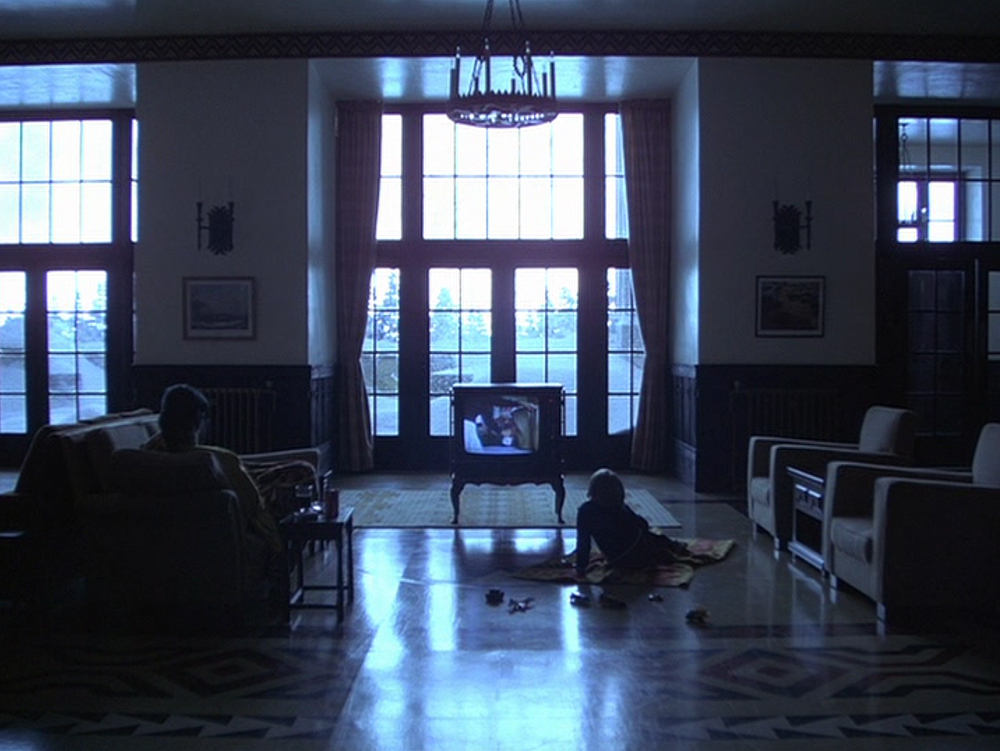
Although intentionally venturing into the horror territory, The Shining isn’t keen to follow the classic tropes that have defined this cinema genre for years: “Instead of the cramped darkness and panicky quick editing of the standard-issue scary movie, Kubrick gives us the eerie, colossal, brilliantly lit spaces of the Overlook Hotel (created in Elstree Studios, Hertfordshire), shot with amplitude and calm. It looks like an abandoned city […]” (Bradshaw Peter, 2012). Kubrick therefore doesn’t need a grim, distorted set to install a sense of panic and madness. Although underlined by sickly colour combinations in the carpets and wallpapers, the malignant character of the hotel is expressed in sleek, sterile and empty interior designs, washed with white light. Additionally, where many horror films exploit the fear of small spaces, The Shining tries to spark in its audience an unconscious feeling of agoraphobia. The disproportionate sets that dwarf the characters are made in such way that danger can arise from every direction. In the words of Eric Henderson, it is a “a place where you can hide but you can't run”. (Henderson Eric, 2007)
The specific type of architecture in hotels also helps conveying this sentiment of insecurity. When the ghost-like movements of a steadicam follow Danny on his tricycle, we realise corridors are linked without interruption, resulting in a never-ending maze that traps the protagonists inside a single, tortuous space. The resonant quality of the high ceiling lobbies further enhances the chilling, atmospheric ambiance of the hallways.
 |
| Figure 2. |
 |
| Figure 3. |
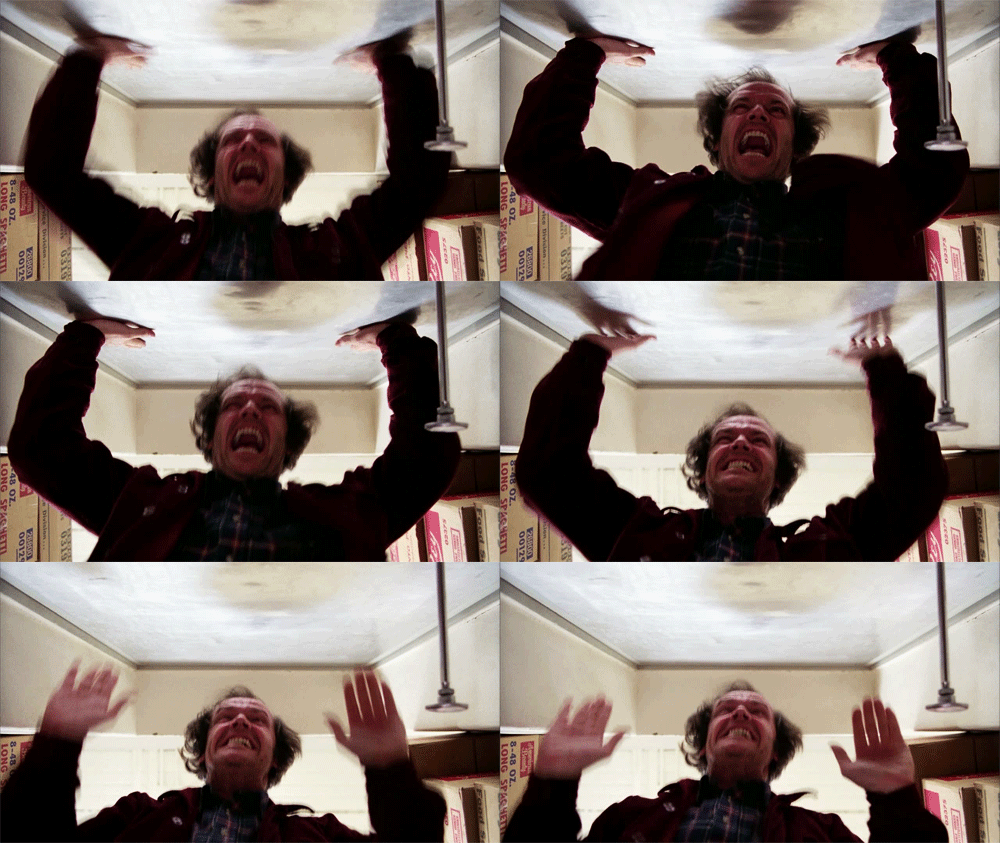
The “insidious unease” is also brought to life with the frequent utilisation of one-point perspective. Less confortable and natural than 1/3-2/3 compositions, it forces the spectators to focus on what is at the very centre of the screen, making us unable to escape the horror we are being shown. The impression of confinement is particularly strong in the scene where the camera is positioned right under Jack’s chin, literally stuck between his body and the door of his temporary prison (see figure 3).
 |
| Figure 4. |
Soundscape-wise, the audio track to The Shining holds no surprise, in the sense that it is everything you would expect it to be and exactly what the film needs to achieve its alarming atmosphere. Its blurring of non-diegetic music into diegetic sounds is however what makes it stand out, magnifying the brewing tension.
Through Jack’s descent into murderous behaviour, the movie touches themes such as family abuse, homicide but also genocide. References to Native American culture are frequently made, be it in the patterns on the walls, the carpets and tapestries or in the fact that the hotel is built upon an ancient burial ground. Although no actual Native American is present amongst the cast, we can remark that the only person to get killed in the film is a non-white character (see figure 5). It has thus been speculated that the hotel being called ‘Overlook’ was meant to express how America had overlooked past massacres.
 |
| Figure 5. |
With that in mind, the ending can be seen as stressing the unconsciously repetitive aspect of human comportment: it seems to suggest how inherent it is to our nature to commit atrocities against our own kind – in the case of The Shining, our own family – and effortlessly forget about them. It is that ability to move on and reiterate with the same violence that transpires as one of the movie’s most frightening material, making Kubrick’s work both intriguing and timeless. And what a better place to stage that metaphor than a hotel, where myriads of closed doors hide on a daily basis the untold horror that guests leave behind, proceeding as if nothing happened?
Bibliography
Bradshaw Peter. (November 1, 2012) The Shining – review. At: http://www.theguardian.com/film/2012/nov/01/the-shining-review (accessed on 29/11/14)
Byrne Joseph. (September 27, 2013) Mise-en-scène in Stanley Kubrick’s The Shining. At: https://engl245umd.wordpress.com/2013/09/27/mise-en-scene-in-stanley-kubricks-the-shining/ (accessed on 29/11/14)
Henderson Eric. (November 20, 2007) The Shining. At: http://www.slantmagazine.com/film/review/the-shining (accessed on 29/11/14)
Illustration List
Figure 1. The Shining (1980) [Poster] At: http://www.impawards.com/1980/shining_ver1_xlg.html (Accessed on 01/12/14)
Figure 2. Lobby Still. (1980) From: The Shining. Directed by: Kubrick, S. [Film still] United States-United Kingdom: Warner Bros. At: http://idyllopuspress.com/idyllopus/film/shining_monday.htm (Accessed on 01/12/14).
Figure 3. Storage Room GIF. (1980) From: The Shining. Directed by: Kubrick, S. [Film still] United States-United Kingdom: Warner Bros. At: http://www.qbn.com/topics/682663/ (Accessed on 01/12/14).
Figure 4. Staircase Still (Behind the Scenes). (1980) From: The Shining. Directed by: Kubrick, S. [Photography] United States-United Kingdom: Warner Bros. At: http://www.taringa.net/oyecomovaa/mi/xjp4 (Accessed on 01/12/14).
Figure 5. Murder Still. (1980) From: The Shining. Directed by: Kubrick, S. [Film still] United States-United Kingdom: Warner Bros. At: http://beforeitsnews.com/movies/2012/10/illuminatiwatchers-the-shining-symbolic-analysis-2436630.html?currentSplittedPage=2 (Accessed on 01/12/14).
Bibliography
Bradshaw Peter. (November 1, 2012) The Shining – review. At: http://www.theguardian.com/film/2012/nov/01/the-shining-review (accessed on 29/11/14)
Byrne Joseph. (September 27, 2013) Mise-en-scène in Stanley Kubrick’s The Shining. At: https://engl245umd.wordpress.com/2013/09/27/mise-en-scene-in-stanley-kubricks-the-shining/ (accessed on 29/11/14)
Henderson Eric. (November 20, 2007) The Shining. At: http://www.slantmagazine.com/film/review/the-shining (accessed on 29/11/14)
Illustration List
Figure 1. The Shining (1980) [Poster] At: http://www.impawards.com/1980/shining_ver1_xlg.html (Accessed on 01/12/14)
Figure 2. Lobby Still. (1980) From: The Shining. Directed by: Kubrick, S. [Film still] United States-United Kingdom: Warner Bros. At: http://idyllopuspress.com/idyllopus/film/shining_monday.htm (Accessed on 01/12/14).
Figure 3. Storage Room GIF. (1980) From: The Shining. Directed by: Kubrick, S. [Film still] United States-United Kingdom: Warner Bros. At: http://www.qbn.com/topics/682663/ (Accessed on 01/12/14).
Figure 4. Staircase Still (Behind the Scenes). (1980) From: The Shining. Directed by: Kubrick, S. [Photography] United States-United Kingdom: Warner Bros. At: http://www.taringa.net/oyecomovaa/mi/xjp4 (Accessed on 01/12/14).
Figure 5. Murder Still. (1980) From: The Shining. Directed by: Kubrick, S. [Film still] United States-United Kingdom: Warner Bros. At: http://beforeitsnews.com/movies/2012/10/illuminatiwatchers-the-shining-symbolic-analysis-2436630.html?currentSplittedPage=2 (Accessed on 01/12/14).

Very nice Julien :D
ReplyDeleteJust be careful of your spelling - you have 'the treat is coming from under' instead of 'threat'... whole different scenario!!