
 |
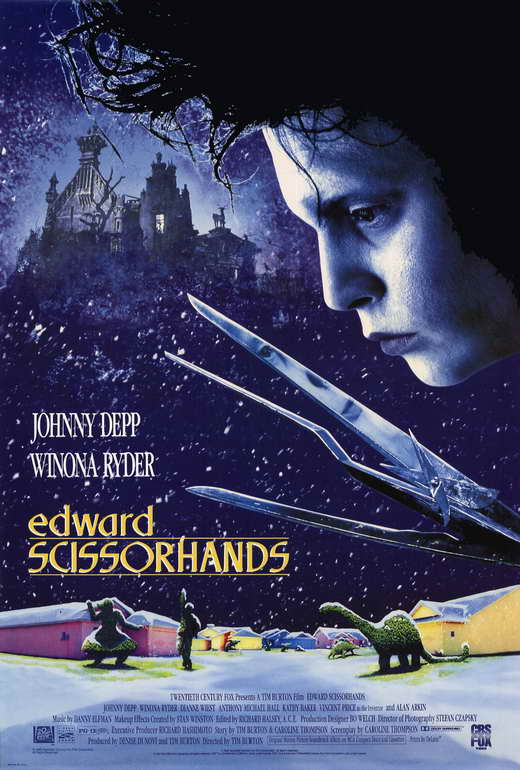 |
| Figure 1. |
The still below (figure 2) introduces us to the two main worlds of the movie. With this distinctive contrast framed in a single shot, the viewers are lead to base their first impressions on the common, stereotyped tropes both environments are attached to: the colourful suburbs look like a safe and lively area whilst Edward’s mansion, distant and sombre, towers menacingly above. The story’s primary theme being about the fear and admiration a creative mind can inspire, the castle on the hill has a curious and inhospitable appearance because it is an individual world others don’t and can’t understand. Whilst the first few minutes of the movie get us acquainted with the tranquil town, we indeed cannot help but being unsettled by the sudden sight of the edifice.
By having Edward’s sanctuary not fitting in the general landscape, Burton successfully conveys the feeling of being ‘out of place’. In its wish to make us look through the eyes of an outsider, the film furthermore brings an alienating perspective on what is considered normalcy, as well as unveiling the sensibility behind the misunderstood ‘other side'. The audience is thus shown, as the uncanny tale unfolds, that “the apparently gloomy castle is in fact a shelter from the seemingly happy outside world, which is in fact much darker and sinister underneath its bright colours.” (Esteryn, 2012)
 |
| Figure 2. |
The two universes meet when, after another fruitless round of door-to-door selling, Avon lady Peg decides to pay a visit to Edward’s remote residence. As we enter a place radically different from the American suburban streets, the director and his team capture the chill of the unknown by shooting the sequence just like the prelude to a classic horror movie. Peg’s petite and bright silhouette accentuates the spacious dimension of the set as she walks through the seemingly abandoned, monochromatic interior (see figure 3). We are soon to understand however that the only lugubrious thing about the aslant mansion is its loneliness.
 |
| Figure 3. |
 |
| Figure 4. |
 |
| Figure 5. |
 |
| Figure 6. |
 |
| Figure 7. |
If they had first considered Edward as an exciting oddity, the neighbourhood who fails to engage with the young man and understand his nature are quick to turn against him. This is where the scissors metaphor, both a motor of fright and wonder for the town residents, works the most efficiently as it is can be interpreted in two ways: on the one hand, as a creative tool and on the other, as a destructive, dangerous instrument. If Edward is able to express his artistic personality into the world by shaping everyday elements into something completely new, his hands also have the capacity to communicate his frustrations onto his surroundings. Cinematographically speaking, the effect offered on-screen by the lethal appendices is a very evocative way of translating the character’s emotions without relying on speech or facial expressions. Edward can thus be seen as experiencing anger when he uses the blades like claws on the wallpapers or to damage his creations. But most importantly, it is the handicapping aspect of these scissor-hands in everyday tasks that visually emphasises his inability of ‘being like the others’. Though, as Steve Biodrowski reminds us, Tim Burton’s final intention is to demonstrate that “the very characteristic that separates him from everyone else also makes him special.” (Biodrowski, 2000)
Although the director’s depiction of suburbia might be viewed as judgemental, the film nuances its comment by showing the goodness and acceptance that can simultaneously emerge from that eccentrically banal environment. The most evident example being Kim’s journey from mistrust to love, we can also take into account Joyce’s last distressed look towards the place where Edward is said to have met his end, giving an unexpected glimpse of depth to the character. As Tim Burton is reported to have stated in an interview, suburbia is after all not specifically “a bad place, it's a weird place”. (Easton, 1990)
--------
Hi Jackie! I apologize if there are more spelling/grammar mistakes than before as I haven't been able to get my last four reviews checked by a native speaker. I try my best to minimize the amount of them though :)
Bibliography
Biodrowski, S. (2000). Edward Scissorhands – Film & DVD Review | Cinefantastique Online. At: http://cinefantastiqueonline.com/2000/10/edward-scissorhands-tim-burtons-elephant-man/ (Accessed on: 06/12/14).
Easton, N. J. (1990) “For Tim Burton, this one’s personal” At: http://www.timburtoncollective.com/articles/es7.html (Accessed on: 08/12/14)
Edelstein, D. (1990) ‘Odd Man In’ In: Burton, T. (2005). Tim Burton: Interviews. Jackson: Univ. Press of Mississippi. pp.35
Esteryn, A. (2012) “Edward Scissorhands: A review of Tim Burton’s film”. At: http://coco.raceme.org/films/edwardscissorhands/review.php (Accessed on: 06/12/14)
Illustration List
Figure 1. Edward Scissorhands (1990) [Poster] At: http://www.moviepostershop.com/edward-scissorhands-movie-poster-1990 (Accessed on 08/12/14)
Figure 2. Castle and Town Still. (1980) From: Edward Scissorhands. Directed by: Burton, T. [Film still] United States: 20th Century Fix. At: http://anthonyho-arch1390.blogspot.co.uk (Accessed on 08/12/14)
Figure 3. Castle Staircase Still. (1980) From: Edward Scissorhands. Directed by: Burton, T. [Film still] United States: 20th Century Fix. At: http://anthonyho-arch1390.blogspot.co.uk (Accessed on 08/12/14)
Figure 4. Inventor's Lab Still. (1980) From: Edward Scissorhands. Directed by: Burton, T. [Film still] United States: 20th Century Fix. At: http://anthonyho-arch1390.blogspot.co.uk (Accessed on 08/12/14)
Figure 5. Attics Still. (1980) From: Edward Scissorhands. Directed by: Burton, T. [Film still] United States: 20th Century Fix. At: http://anthonyho-arch1390.blogspot.co.uk (Accessed on 08/12/14)
Figure 6. Suburban Living Room Still. (1980) From: Edward Scissorhands. Directed by: Burton, T. [Film still] United States: 20th Century Fix. At: http://aloneinneverland.blogspot.co.uk/2009/12/movie-i-want-to-live-in-1-edward.html (Accessed on 08/12/14)
Figure 7. Kim's Bedroom Still. (1980) From: Edward Scissorhands. Directed by: Burton, T. [Film still] United States: 20th Century Fix. At: http://aloneinneverland.blogspot.co.uk/2009/12/movie-i-want-to-live-in-1-edward.html (Accessed on 08/12/14)
Illustration List
Figure 1. Edward Scissorhands (1990) [Poster] At: http://www.moviepostershop.com/edward-scissorhands-movie-poster-1990 (Accessed on 08/12/14)
Figure 2. Castle and Town Still. (1980) From: Edward Scissorhands. Directed by: Burton, T. [Film still] United States: 20th Century Fix. At: http://anthonyho-arch1390.blogspot.co.uk (Accessed on 08/12/14)
Figure 3. Castle Staircase Still. (1980) From: Edward Scissorhands. Directed by: Burton, T. [Film still] United States: 20th Century Fix. At: http://anthonyho-arch1390.blogspot.co.uk (Accessed on 08/12/14)
Figure 4. Inventor's Lab Still. (1980) From: Edward Scissorhands. Directed by: Burton, T. [Film still] United States: 20th Century Fix. At: http://anthonyho-arch1390.blogspot.co.uk (Accessed on 08/12/14)
Figure 5. Attics Still. (1980) From: Edward Scissorhands. Directed by: Burton, T. [Film still] United States: 20th Century Fix. At: http://anthonyho-arch1390.blogspot.co.uk (Accessed on 08/12/14)
Figure 6. Suburban Living Room Still. (1980) From: Edward Scissorhands. Directed by: Burton, T. [Film still] United States: 20th Century Fix. At: http://aloneinneverland.blogspot.co.uk/2009/12/movie-i-want-to-live-in-1-edward.html (Accessed on 08/12/14)
Figure 7. Kim's Bedroom Still. (1980) From: Edward Scissorhands. Directed by: Burton, T. [Film still] United States: 20th Century Fix. At: http://aloneinneverland.blogspot.co.uk/2009/12/movie-i-want-to-live-in-1-edward.html (Accessed on 08/12/14)

That banner is gorgeous! :)
ReplyDeleteThank you :D
Delete