
 |
 |
| Figure 1. |
First instalment of the director’s ‘Appartment Trilogy’, Roman Polanski’s Repulsion (1965) presents itself to be an intense cinematic experience all the way through. It ranks among movies that made modern-day horror hit closer to home, since most of its disturbing scenes take place in a Kensington flat. But Repulsion is also the perfect example of how a world can be visually wrapped around a character’s psyche.
Set in swinging London, the film focuses on the young Carol’s gradual mental collapse as her fear and repulsion for men take on dramatic proportions. Although it is made clear her paranoia is there from the get-go, the Belgian beautician’s mind truly begins to fracture when her sister goes on holyday (to see the symbolic ‘leaning tower of Pisa’), leaving her alone for a few days.
Daydreaming during her work hours, we follow Carol as she sleepwalks through the busy streets that seemingly endure constant renovations. The cracks appearing around her are amongst the first signs of her growing distress, when unwanted male attention becomes overwhelming. “All these leering, groping males make her flesh crawl, causing her to twitch and wipe at her face and body as if to rid herself of some dread disease transmitted by men” (Viola M., 2008). Her only shelters turn out to be her workplace and the privacy of the apartment she shares with her older sister but even there, her comfort zone starts to be invaded by the latter’s lover and the men’s infidelity appears to be a regular topic of conversation at the beauty salon.
Theatre of her crumbling mental state, Carol’s flat could be seen as both representing her mind and body. Throughout the movie, noises coming from the 'outside world', such as phone rings and doorbells, get louder and louder, being perceived as undesired penetrations into her personal space. However, silence is also used to intensify the horror of several scenes: during the young woman’s rape hallucinations, her cries are inaudible, making the audience feel terrifyingly helpless. Only the haunting ticking of a clock remains through the efficiently edited sequences – sound effect reused later in Rosemary’s Baby (Dir: Polanski R., 1968) for equally disturbing scenes. Simultaneously, when Carol is left to herself and the calmness of the apartment takes over, everyday noises get realistically amplified to the point of getting piercing. As for the soundtrack, the flute, bass and drums either achieve an absorbing or alarming mood.
 |
| Figure 2. |
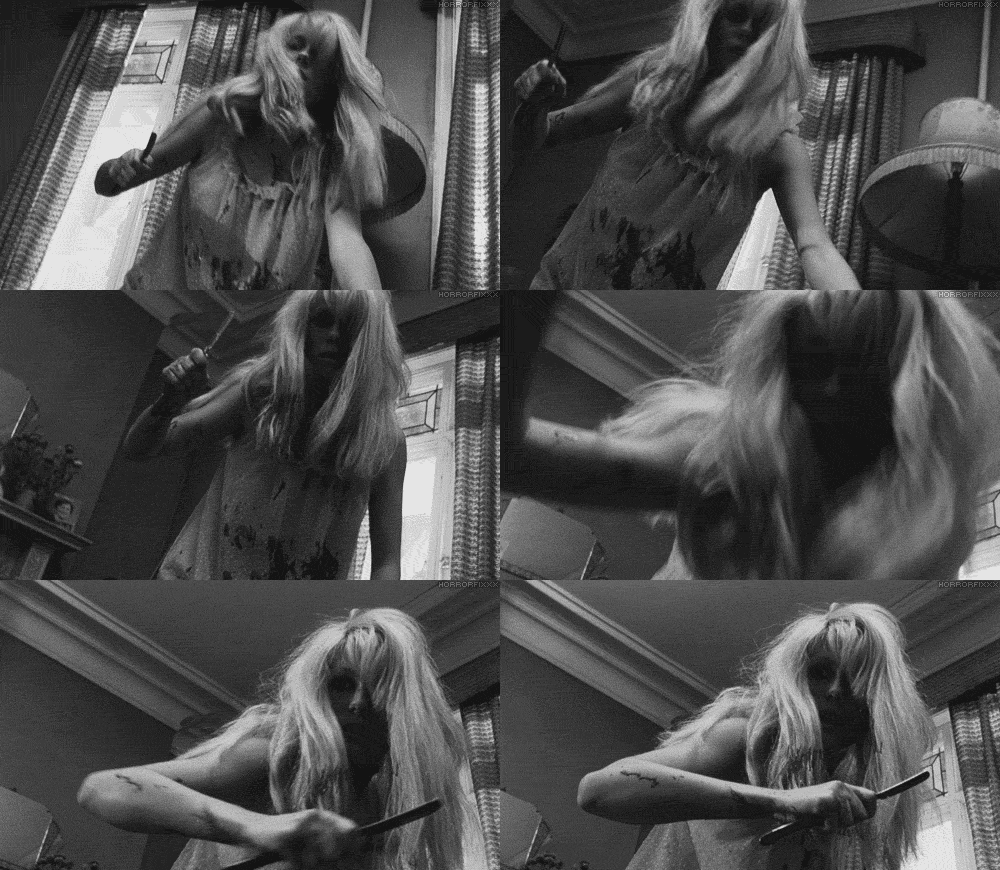
When the protagonist starts to lose grip on reality, her behaviour becomes erratic and primal. She acts by instinct, killing any male intruder who threatens her sanctuary. Although committing murder, Carol is ambiguously made to feel more like the victim than her targets. “In response to Colin's declaration, Carol murders him with a candlestick. With each thump, the camera wobbles. We, the voyeuristic watchers - the men - assume the place of Colin's battered head. And so it is that Polanski aligns us – the spectators – with the predatory male gaze that so repulses and overwhelms Carol.” (Cummings B., 2013) (see figure 2)
To portray the way she feels, her surroundings begin to distort and the previously small rooms stretch in uncomfortably long corridors (see figure 3). The intimacy she fears so much makes its way on the partitions that takes a fleshy, gleaming texture. Hands protrude from the walls, reaching for her body. The whole apartment seems to inevitably trap the heroine, the ceiling looking as though it wished to crush her. In the same way as Psycho (Dir: Hitchcock A., 1960), the use of black and white photography might have been preferred to tone down the intensity of Carol’s visions. The film reaches its climax when nightmarish hallucinations succeed one another, making us lose any sense of time as the rabbit left to rot reflects the decaying state of her mind.
 |
| Figure 3. |
While it could be said Carol simply suffers from schizophrenia or longs for the company of women only – working in a feminized environment and enviously staring at the convent across her backyard – the picture shown at several points in the movie offers another explanation for the character’s repulsion. The first time the family photograph appears on screen, a young Carol seems to look at a relative with a mortified expression. In the last scene, an impressive camera pan stops on the picture again, the light framing hers and the relative’s face with more precision. Catherine Deneuve, in her portrayal of the troubled young lady, also adopts the posture and way of speaking of a little girl, suggesting a mental state Carol might have been trapped in since a traumatic childhood experience. However, Polanski is said to have denied this theory, leaving Repulsion open to many more interpretations.
Bibliography
Cummings, Basia Lewandowska. (January 4th, 2013) Deneuve-Shredding: Repulsion Revisited. At: http://thequietus.com/articles/11038-repulsion-roman-polanski-bfi-reissue (accessed on 26/11/14)
MacIntyre, Elaine (s.d.) Repulsion (1964). At: http://www.elainemacintyre.net/film_reviews/repulsion.php (accessed on 26/11/14)
Viola, Mat. (2008) REPULSION (ROMAN POLANSKI, 1965). At: http://notesofafilmfanatic.com/?p=18 (accessed on 26/11/14)
Illustration List
Figure 1. Repulsion (1965) [Poster] At: http://www.filmposters.com/movie-poster.asp?ProdID=13831 (Accessed on 26/11/14)
Figure 2. Landlord Murder GIF. (1965) From: Repulsion. Directed by: Polanski, R. [Film GIF] UK: Compton Films Royal Films International. At: http://cinematiccorner.blogspot.co.uk/2012/06/movie-of-month-june-repulsion.html (Accessed on 26/11/14).
Figure 3. Distorted Bathroom still. (1965) From: Repulsion. Directed by: Polanski, R. [Film still] UK: Compton Films Royal Films International. At: http://www.myreviewer.com/DVD/129832/Repulsion-Digitally-Remastered-Edition/130253/JPEG (Accessed on 26/11/14).
Illustration List
Figure 1. Repulsion (1965) [Poster] At: http://www.filmposters.com/movie-poster.asp?ProdID=13831 (Accessed on 26/11/14)
Figure 2. Landlord Murder GIF. (1965) From: Repulsion. Directed by: Polanski, R. [Film GIF] UK: Compton Films Royal Films International. At: http://cinematiccorner.blogspot.co.uk/2012/06/movie-of-month-june-repulsion.html (Accessed on 26/11/14).
Figure 3. Distorted Bathroom still. (1965) From: Repulsion. Directed by: Polanski, R. [Film still] UK: Compton Films Royal Films International. At: http://www.myreviewer.com/DVD/129832/Repulsion-Digitally-Remastered-Edition/130253/JPEG (Accessed on 26/11/14).

Once again, a great review Julien :)
ReplyDelete