
 |
 |
| Figure 1. |
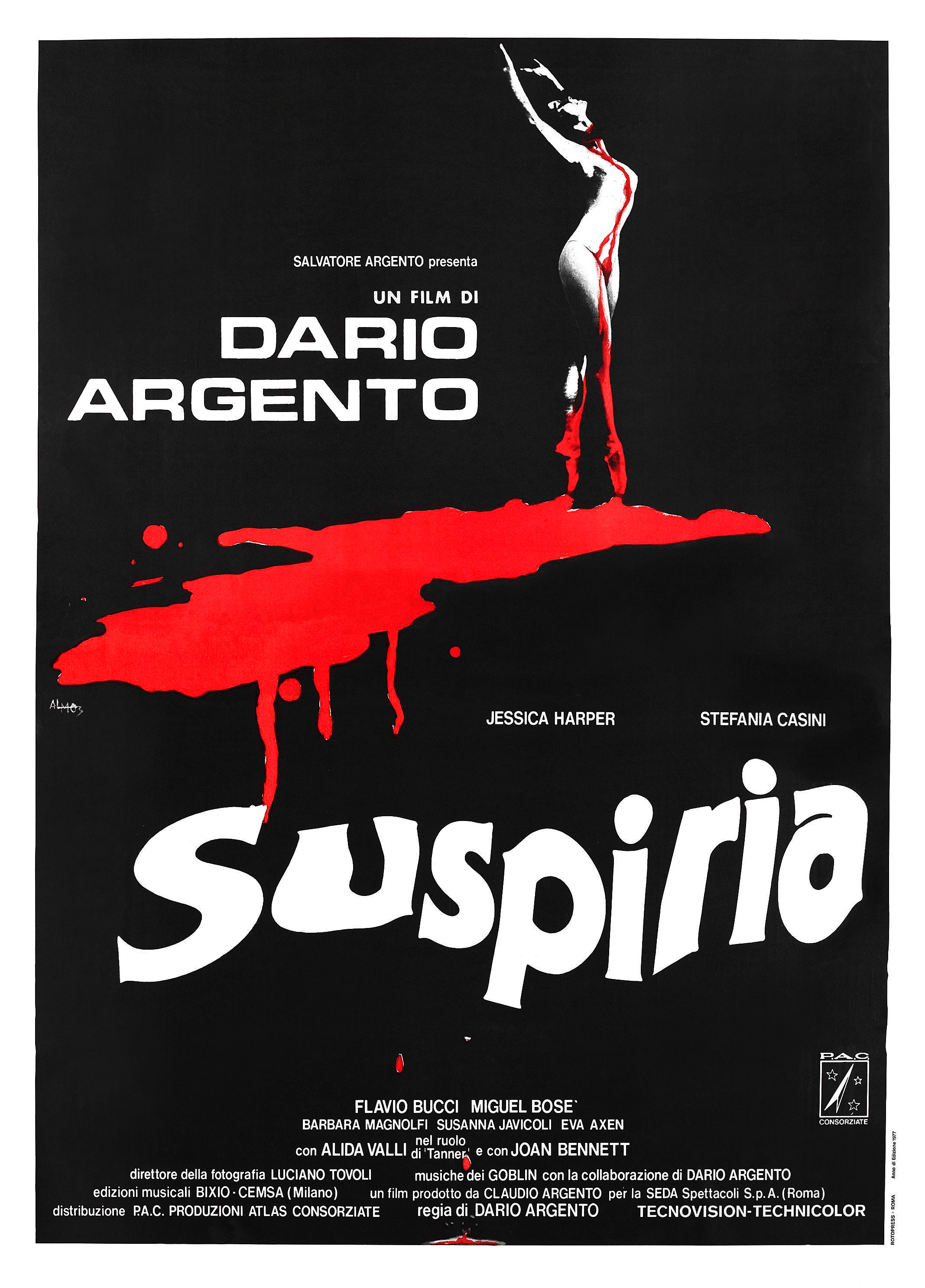
Distributed in 1977, Dario Argento’s Suspiria is the first opus of the director’s ‘Three Mothers’ trilogy. While the plot may feel weak in comparison to the film’s strong visuals, it clearly is in the filmmaker’s intentions to favour appearance over substance. As each scene delivers a new spectacle of fright and gore, the viewers become increasingly aware that the story mainly serves as an excuse for Argento to play around with daring sound design and mise-en-scène. The result is a bewitching cinema exercise that hasn’t lost its spine-chilling potential.
Finding its place within the horror genre, Suspiria is above all a sensorial experience. It not only is a challenge for the eye but also for the ear, making the most of its audio-visual field capacities. If the performers’ voices may at times be no louder than a sigh, impressive scenes are always blaring and backed up with a tumultuous score. Both primitive and electric, the main theme, coupled with screeches, whispers and spectral didgeridoos, doubles the horror of the amplified sounds significantly. The constant shift from quietness to loudness causes an unsettling, almost panic-inducing effect onto the audience, much to Argento’s evident pleasure.
The overwhelming character of the soundtrack is played with very early on in the movie. When the protagonist, Suzie Bannion, is about to leave the neutral space of the Munich terminal, the first few notes of a chilling tune create a feeling of apprehension as to what awaits beyond the airport gates. As the young woman progresses towards the doors, Argento cuts alternately between objective shots filled with diegetic sounds to Suzie’s subjective view, this time accompanied by Goblin’s eerie composition. The director emphasizes the passage from one place to another by abruptly switching the soundscape as soon the heroine hits the exit. Unexpectedly, the calmness of the airport gets drowned under the raging climate of the world outside: “Like a ballerina leaving the safety of her music box, she passes through the airport's automatic doors and hails a taxi in the middle of a torrential rainstorm” (Gonzalez, 2001). This acoustic clash can be seen as a metaphor for culture shock and more specifically for the United States’ perspective on foreign Europe. When Suzie leaves behind her last piece of modern, globalised West, what she enters is an unsafe, sensuous and corrupted – both rich and cheap – wonderland where ancient folklore brews alongside exoticism.
 |
| Figure 2. |
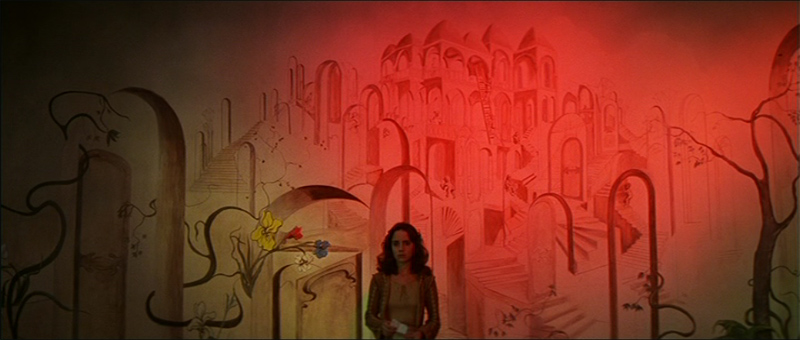
But, in Suspiria, the alarming power of the atmosphere is best conveyed through lighting. We get a first glimpse of Argento’s campy choices at the airport, when a curious red light washes over the arriving passengers like a bright warning sign. The following scenes carry on with the same idea as Suzie embarks on a turbulent cab drive towards the fairytale-esque Black Forest: neon blue lights provide a vivid counterpoint to the red radiance that splatters the dancer’s skin like blood (see figure 2). But it is in the Freiburg Academy of Ballet that Argento's unnatural flood of Crayola colour schemes reaches its peak. Although important elements are sometimes highlighted in a different hue to serve as clues for the audience’s eyes, these primary reds, greens, blues and yellows are often projected with seemingly no other purpose than to saturate the sets and actresses in a primal, surreal manner. Since Suspiria’s nightmarish mise-en-scène is meant to visually affect its viewers more than its characters, Argento allows himself, as Suzie and Sarah start to go down the rabbit’s hole, to make the lighting incoherent from one shot to another and turn what should be obscurity into an otherworldly tinted gloom.
 |
| Figure 3. |
But if we consider those garish tones as designed to mimic the American unease towards Europe, the settings do not disappoint either. Suspiria displays such an explosion of styles that it almost seems like a tourist has regurgitated all at once snapshot visions of galleries, palazzi and historic landmarks visited previously. Whilst the façade of the Academy screams nothing but danger with its medieval ornaments and lurid red shade (see figure 5), the architecture of the interiors can be compared to a crossing between modern and past centuries. The impressive set pieces feature Gothicised Art Nouveau corridors, flowery Baroque wallpapers, Mondrian-inspired mirrors and a most memorable 70s psychedelic take on Art Deco, complete with vibrant stained-glass windows and geometric tiled floor.
 |
| Figure 4. |
 |
| Figure 5. |
If the film hallucinatory mise-en-scène could be interpreted as an alienating look on foreign culture, it is equally possible the director drew his harrowing staging from his self-confessed ‘incomprehension’ of women (the Academy being a primarily feminized milieu). In her analysis of the patriarchal fear of female power and sexuality that translates it into witchcraft, Keala Jewell points out about the scenic discontinuity of Suzie’s meeting outside the school: “It is important that Suzy’s interview with the psychiatrist is the only sequence in the entire film shot in a realistic way (the on-location set, use of natural lighting, the public space, and the realistic mise-en-scène). Consistent with Gothic representation, the film iconographically codifies the diurnal world as symbolizing the truth, reality and reason. Furthermore, it genders that world masculine, setting up the binary opposition to the dangerous, feminine, nocturnal world” (Jewell, 2001). Male figures inhabiting the dark institution are therefore often impaired or weaker than the redoubtable female staff.
Although Suspiria deserves improvement within its storytelling (the poster suggested a very striking yet sensually macabre finale), Argento’s experiment remains a fascinating enterprise into the horror genre. And one can always wonder upon seeing the last vision of Suzie, grinning as she rushes outside the burning establishment, if the fantastical events occurred in a shared reality or in the distressed mind of an individual. The film's dreamlike quality could indeed lead us to question whether Suzie’s struggle against the coven was in fact a magnified distortion of what she truly faced… Did the promiscuous, exotic atmosphere of European boarding schools, source of so many students’ myths, have the same overwhelming effect as the Himalayan nunnery on the Sisters of Black Narcissus (Powell & Pressburger, 1947)?
Bibliography.
Jewell, K. (2001). Monsters in the Italian literary imagination. Wayne State University Press.
Giusti, G. (2013). Suspiria. At: (Accessed on 4/01/15)
Gonzalez, E. (2001). Suspiria. At: http://www.slantmagazine.com/film/review/suspiria (Accessed on 30/12/14)
Illustration list.
Figure 1. Suspiria (1977) [Poster] At: http://boingboing.net/2014/08/13/bang-your-eyes-the-13-hardest.html (Accessed on 04/01/15)
Figure 2. Taxi Still. (1977) From: Suspiria. Directed by: Argento, D. [Film still] Germany (Weimar Republic): Seda Spettacoli. At: http://dicasdefilmespelascheila.blogspot.co.uk/2014/05/filme-suspiria-1977.html (Accessed on 23/12/14).
Figure 3. Madame Blanc's Office Still. (1977) From: Suspiria. Directed by: Argento, D. [Film still] Germany (Weimar Republic): Seda Spettacoli. At: http://cinefantastiqueonline.com/2008/06/nostalgia-suspiria-1977/ (Accessed on 23/12/14).
Figure 4. Madame Blanc's Office Still 2. (1977) From: Suspiria. Directed by: Argento, D. [Film still] Germany (Weimar Republic): Seda Spettacoli. At: http://cinematicduske.blogspot.co.uk/2011_02_01_archive.html (Accessed on 23/12/14).
Figure 5. Tanz Akademie Façade Still (1977) From: Suspiria. Directed by: Argento, D. [Film still] Germany (Weimar Republic): Seda Spettacoli. At: http://stillsfrmfilms.wordpress.com/2013/11/24/suspiria/ (Accessed on 04/01/15)
Figure 3. Madame Blanc's Office Still. (1977) From: Suspiria. Directed by: Argento, D. [Film still] Germany (Weimar Republic): Seda Spettacoli. At: http://cinefantastiqueonline.com/2008/06/nostalgia-suspiria-1977/ (Accessed on 23/12/14).
Figure 4. Madame Blanc's Office Still 2. (1977) From: Suspiria. Directed by: Argento, D. [Film still] Germany (Weimar Republic): Seda Spettacoli. At: http://cinematicduske.blogspot.co.uk/2011_02_01_archive.html (Accessed on 23/12/14).
Figure 5. Tanz Akademie Façade Still (1977) From: Suspiria. Directed by: Argento, D. [Film still] Germany (Weimar Republic): Seda Spettacoli. At: http://stillsfrmfilms.wordpress.com/2013/11/24/suspiria/ (Accessed on 04/01/15)

'Suspiria displays such an explosion of styles that it almost seems like a tourist has regurgitated all at once snapshot visions of galleries, palazzi and historic landmarks visited previously.' - Fantastic review Julien! A good start to the new year :)
ReplyDeleteThat was quick! Thank you so much :)
DeleteExcellent, Julien - I just sat back and read this for my own enjoyment. You write about film with enthusiasm and great style. There's just a typo for tidying up:
ReplyDelete'In her *analyse* (analysis) of the patriarchal fear of female power and sexuality that translates it into witchcraft...'